Collaborative Chemical Data Analysis Integrating Federated Learning and Secure Multi-Party Computation
DOI:
https://doi.org/10.64972/dea.2025.v4i3.2452d:13-26Keywords:
federated learning, secure multi-party computation, chemical informatics, privacy protection, distributed modelingAbstract
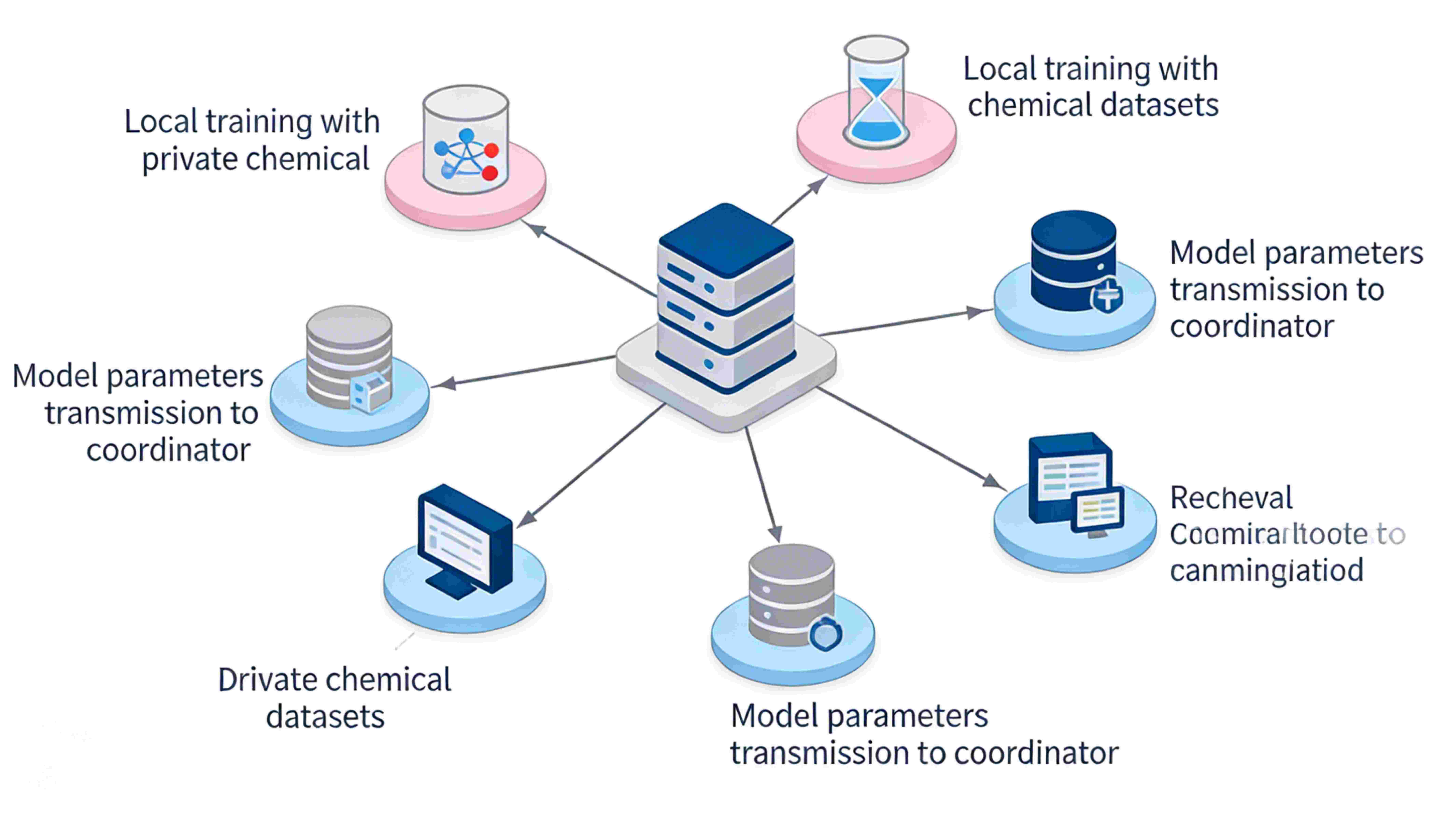
Developed a dedicated federated learning framework that combines secure multi-party computation to address the efficiency and privacy issues of distributed chemical data analysis. By securely aggregating models thru homomorphic encryption and secret sharing, many organizations can train machine learning models without exchanging raw chemical data. The experimental evaluation used various chemical datasets that simulated non-independent and identically distributed scenarios in the real world. As for the results, it can be observed that this combination reduces privacy leakage and adversarial reasoning. It also remains competitive with centralized learning in terms of accuracy and convergence time. In order to scale to large networks and high-dimensional models, quantization and update sparsification have optimized communication and computational demands. Empirical results demonstrate that this framework is suitable for cross-organizational cheminformatics, with strong collaborative analysis capabilities and robust sensitive information protection.
Downloads
Published
How to Cite
Issue
Section
License
Copyright (c) 2026 Chiara Giordano, Egidio Veronese

This work is licensed under a Creative Commons Attribution-NonCommercial-ShareAlike 4.0 International License.