Sensor Fusion Data Noise Suppression Technology Based on Generative Adversarial Networks
DOI:
https://doi.org/10.64972/dea.2025.v4i1.1917d:84-97Keywords:
Sensor Fusion, Generative Adversarial Network, Noise Suppression, Multi-Modal Learning, Deep Learning, Signal ProcessingAbstract
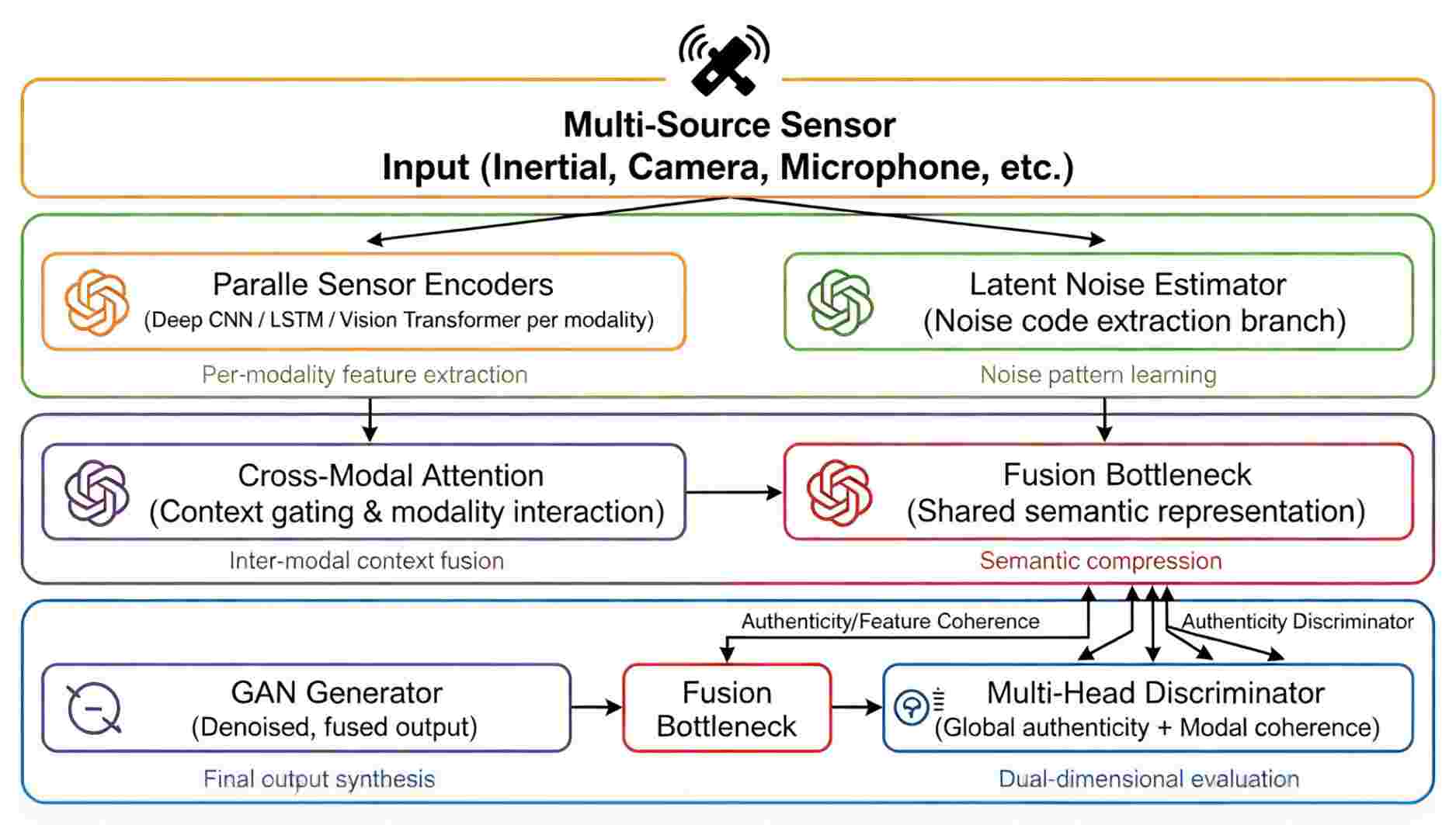
Sensor fusion enables many intelligent systems (such as robots and autonomous vehicles) to simultaneously acquire precise environmental data. It is still a problem to obtain accurate and reliable fusion results, as the complex and non-stationary noise in multi-sensor data remains an issue. Based on the above information, this paper will introduce a new framework based on Generative Adversarial Networks (GANs) to improve the denoising and fusion of multimodal data. To learn heterogeneous dependencies and contextual noise patterns, the structure employs parallel deep encoders for different sensor modalities, as well as cross-modal attention mechanisms and adaptive noise estimation branches. The proposed method improved the median fusion signal-to-noise ratio by 23.1 dB, surpassing traditional Kalman filtering and deep autoencoding methods by 6.8 dB. This method is based on synthetic and real-world datasets from experiments. Under all noise conditions, the modal coverage metric remains above 0.91, and the metrics for cross-modal feature alignment and information retention have significantly improved. This framework can improve the accuracy and stability of sensor data. GAN-based methods provide a scalable and highly adaptable solution for next-generation sensor fusion, suitable for deployment in the uncertain and dynamic real world.
Downloads
Published
How to Cite
Issue
Section