Bidirectional GRU-Attention Network for Intelligent Industrial Fault Report Classification
DOI:
https://doi.org/10.64972/dea.2026.v5i2.1711d:1-14Keywords:
Fault Diagnosis, Deep Learning, Industrial Automation, Text MiningAbstract
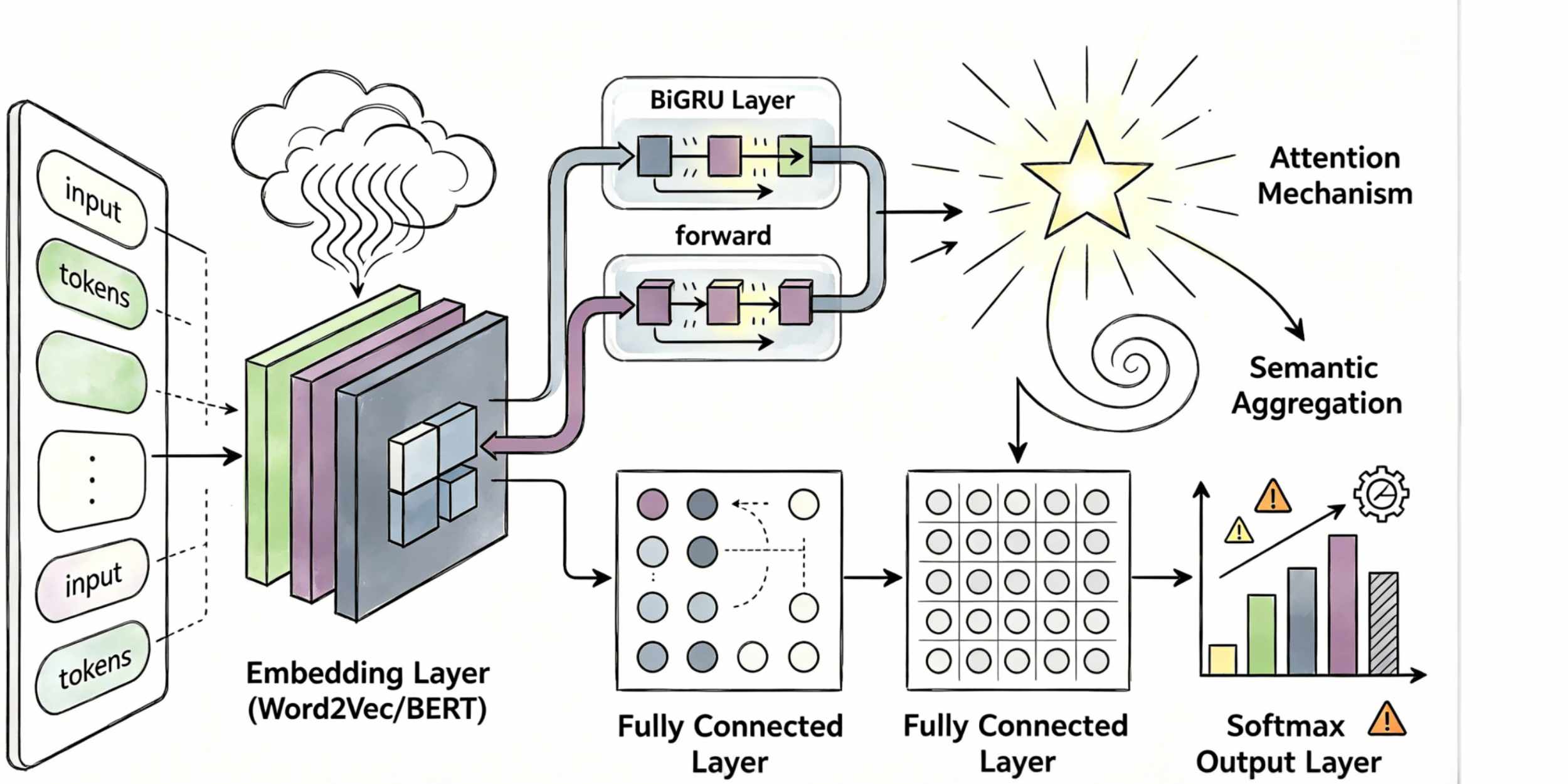
The industry's stated issues are growing more complicated as intelligent manufacturing advances quickly, necessitating more accurate automatic analysis. The aforementioned items must be arranged in order to support data-driven production management, minimise operating disruptions, and enable prompt maintenance. In order to learn thoroughly from a variety of narratives and technical jargon in industrial reports, this work has built a new classification system and incorporated an attention mechanism with a Bidirectional Gated Recurrent Unit (BiGRU). In order to extract features and reduce informational noise, a bespoke pre-processing pipeline is used that incorporates domain-specific tokenisation and embeddings. The suggested approach is thoroughly tested using a large-scale industrial dataset of 18,734 annotated defect reports, which shows notable differences in text length and class imbalance. According to the experimental results, the BiGRU-Attention model outperforms both the neural baseline and the conventional technique in terms of accuracy and macro F1-score. It is also highly effective at identifying uncommon fault kinds. The framework has been succinctly documented in error analysis and is very adept at managing ambiguous expressions. The model is practical and successful as an intelligent fault-detection tool for enhancing industrial maintenance decision-support capabilities, according to the aforementioned findings.
Downloads
Published
How to Cite
Issue
Section