Time Series Prediction of Equipment Downtime in Smart Factories Based on Long Short-Term Memory Networks
DOI:
https://doi.org/10.64972/dea.2026.v5i1.16810d:130-146Keywords:
Time Series Prediction, LSTM Networks, Smart Factory, Predictive Maintenance, Equipment FailureAbstract
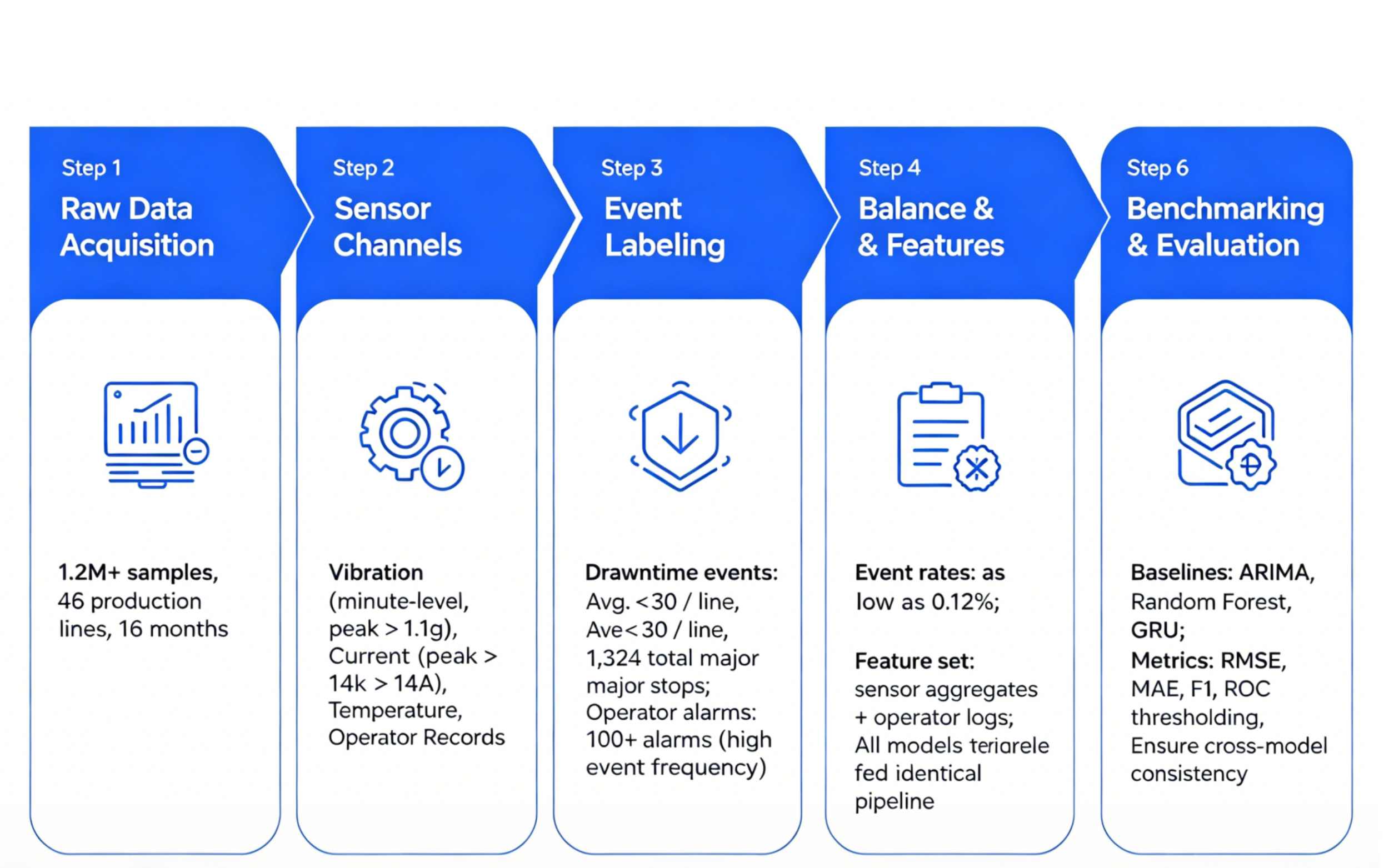
In a smart-factory setting, prompt prediction of equipment failure is necessary to minimise losses in production efficiency and maintenance costs. In order to address the challenge of modelling diverse and high-dimensional industrial time series, this study will propose a specific Long Short-Term Memory (LSTM) model. Multiple sources of sensor data, operator records, and statistical indicators gathered from 46 production lines over the last 16 months have been integrated into a single data fusion pipeline. To capture non-linear failure dynamics, an LSTM network with attention will be used after improving the robustness of the model's input and utilising sophisticated feature engineering and temporal alignment. According to the experiment, the suggested model outperforms the conventional ARIMA and Random Forest techniques with a root mean square error of less than 8 minutes and a mean absolute error of nearly 5 minutes on new production lines. The framework is reasonably resilient to noisy sensors and missing data, and it has an accuracy of over 91% for failure prediction and anomaly detection in robots, hydraulic, and conveyor systems. Vibration entropy, current surges, and human intervention logs are all required for early warning production, according to the interpretation results. In addition to offering technical references for industry decision-makers, this study offers concrete support for using deep sequential learning in the predictive maintenance of highly automated facilities.
Downloads
Published
How to Cite
Issue
Section