Deep Learning-Based Weld Seam Quality Assessment Using a Joint ResNeXt101 and AdaBound Model
DOI:
https://doi.org/10.64972/dea.2026.v5i1.1635d:60-72Keywords:
Deep Learning, Weld Defect Detection, Grouped Convolution, Adaptive Optimization, Data Augmentation, Industrial Inspection, RobustnessAbstract
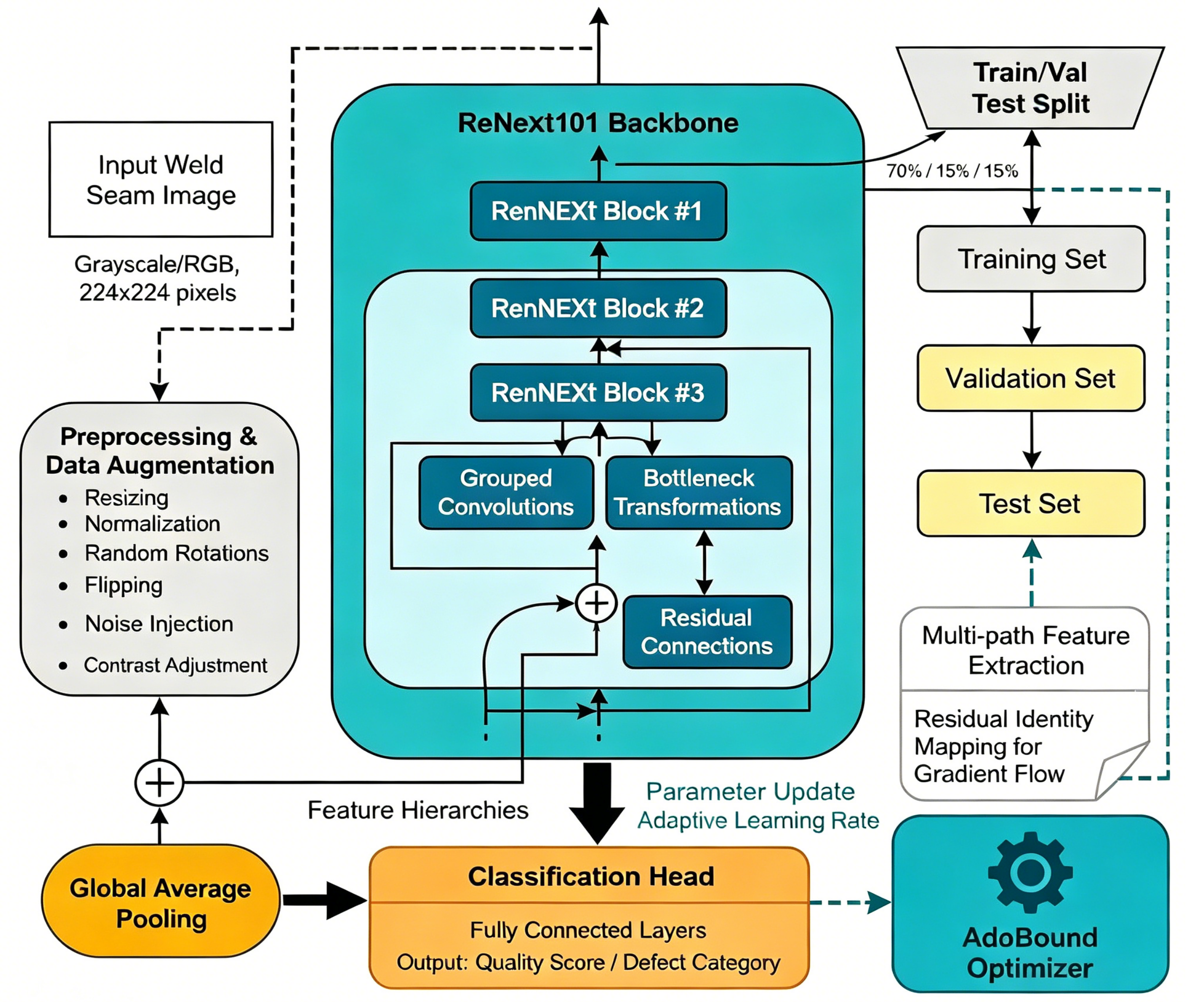
Due to the application of computer vision technology, weld defect detection has become relatively reliable and efficient in the industrial field. By combining the ResNeXt101 backbone with the AdaBound adaptive optimizer, a hybrid deep learning model was constructed to achieve long-term effective welding quality assessment. The techniques used to enhance the effectiveness of comprehensive data augmentation are grouped convolution feature extraction and dynamic learning rate adjustment. In the experiment, two large-scale, multi-domain weld seam datasets were used, totaling 21,000 labeled samples. In the positive experiments, the proposed hybrid model outperformed the standard ResNet50 and DenseNet121 baselines, achieving an accuracy of 97.1%, a macro F1 score of 95.0%, and a macro-AUC of 99.2%. Strict ablation studies indicate that the choice of different backbone networks, optimizers, augmentation sets, and input resolutions all have a certain impact on performance improvement. The aforementioned robustness tests indicate that it has good generalization ability for cross-domain data, relatively strong noise tolerance, and balanced performance in detecting both common and rare defect types. The segmentation results indicate that over 92% of the samples have an Intersection over Union (IoU) greater than 0.8, thus they are of high quality. According to the above research results, the hybrid deep learning method has achieved good performance in automatic welding quality inspection. These findings also indicate that the application of this method in large-scale manufacturing has empirical significance.
Downloads
Published
How to Cite
Issue
Section