Feature Selection Random Forest Model for Flood Prediction in Watershed Sensor Networks
DOI:
https://doi.org/10.64972/jiic.2023v1.366p5s:59-73Keywords:
Watershed Sensor Network, Flood Prediction, Random Forest, Hydrological Forecasting, Real-Time WarningAbstract
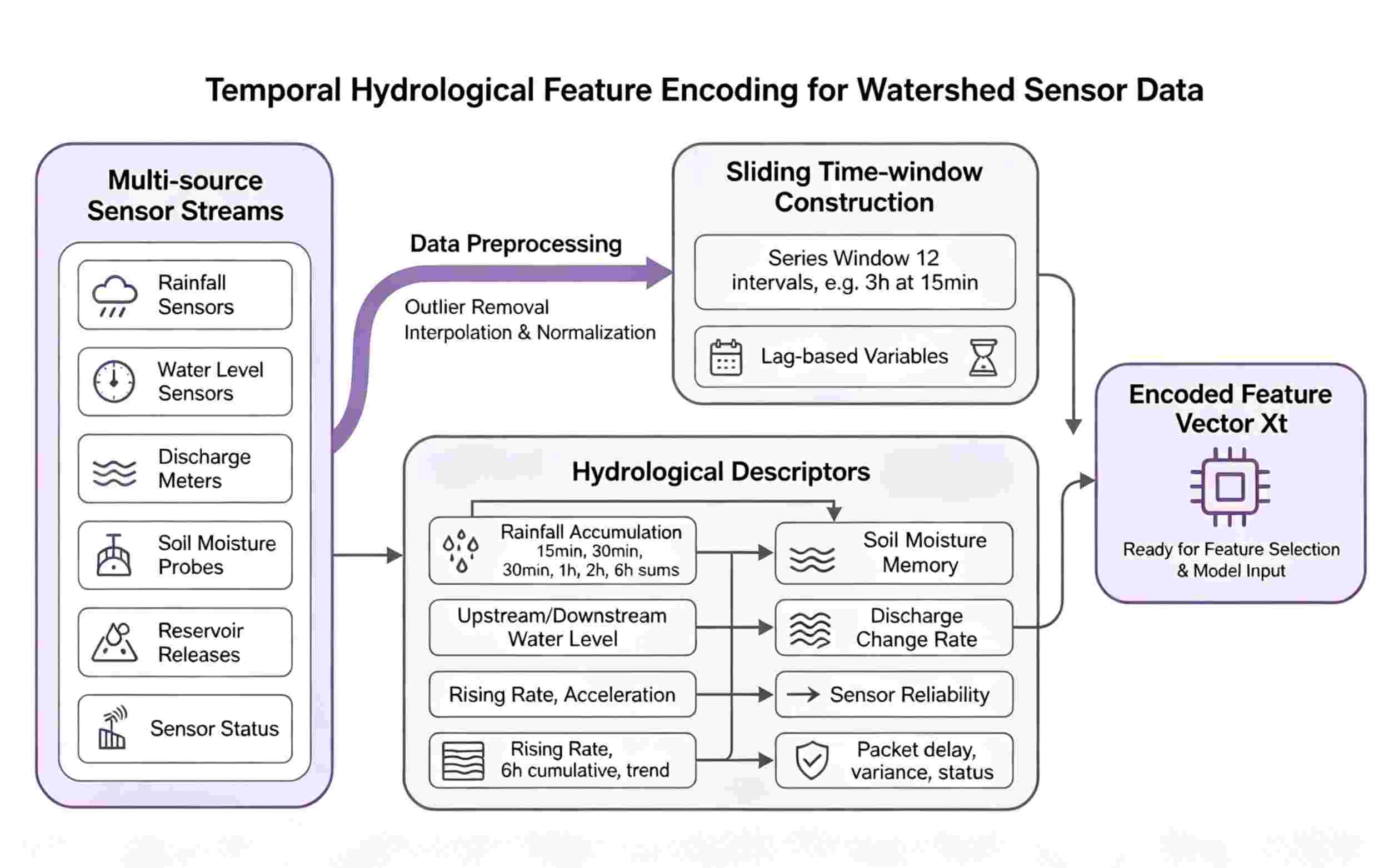
Real-time flood forecasting is impacted by non-linear rainfall-runoff behavior, redundancy of hydrological parameters, and noise in a watershed's sensor network. This paper proposes a feature-selection random forest model for flood risk prediction based on multi-source watershed sensors. The variables for rainfall, upstream water level, discharge, soil moisture, terrain reaction, and transmission quality should first be arranged as time-window descriptors. Before Random Forest training, unstable and overlapping variables are removed using a relevance-redundancy-importance approach. The suggested model is evaluated experimentally against baselines for support vector machines, gradient boosting, traditional Random Forest, LSTM, and XGBoost under normal operation, missing observations, sensor noise, and delayed transmission. On the generated watershed dataset, the suggested model obtained 96.1% accuracy, 95.4% macro-F1, and 94.8% flood-event recall while reducing the feature dimension by 58.7% and maintaining an average inference latency of 7.8 ms. Therefore, a minimal number of hydrological features are picked to increase the prediction accuracy and interpretability. A model for a watershed flood warning system that needs rapid risk classification and sensor-level explanations is presented as an embeddable machine-learning framework.
Downloads
Published
How to Cite
Issue
Section
License
Copyright (c) 2023 Adéla Svoboda, Jakub Dvořák

This work is licensed under a Creative Commons Attribution-NonCommercial-ShareAlike 4.0 International License.