Data Center Energy System Cooling Load Probabilistic Forecasting with a DeepAR-Quantile Model
DOI:
https://doi.org/10.64972/jiic.2023v1.364p3s:27-41Keywords:
Data Center Cooling Load, DeepAR-Quantile, Probabilistic Forecasting, Prediction Interval, Thermal RiskAbstract
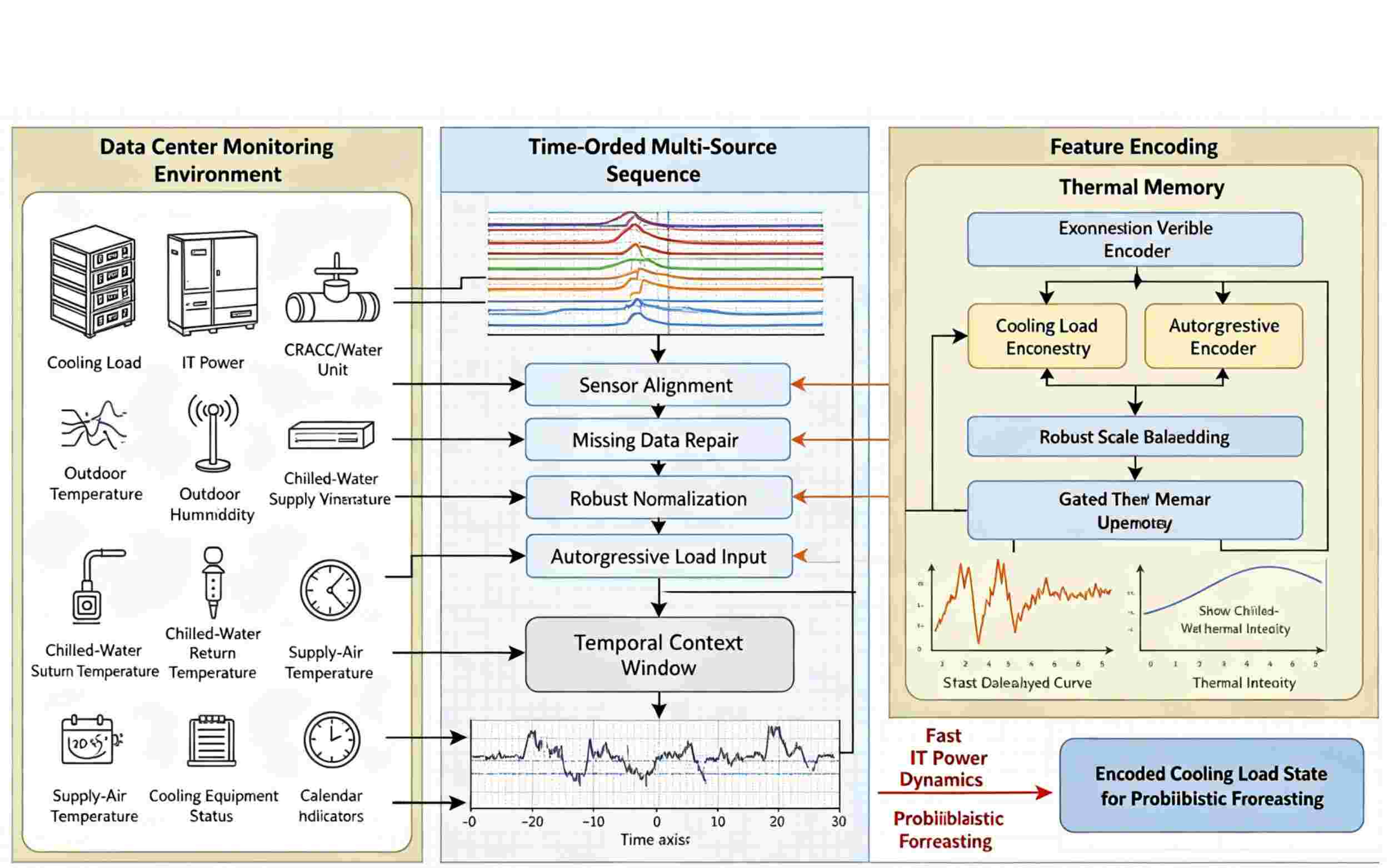
For data center energy systems to operate in an energy-efficient and risk-aware manner, accurate probabilistic cooling load forecasting is necessary. The earlier point forecasting techniques are limited to calculating the average cooling demand and do not account for a number of sources of uncertainty, including variations in chiller performance, workload fluctuations, outside temperature changes, and delayed thermal response. DeepAR-Quantile model for multi-horizon probabilistic cooling load prediction. An autoregressive recurrent structure represents historical cooling demand, IT load, power system data, outdoor weather parameters, chilled-water/supply-air temperatures, and operational circumstances. The model enables prediction intervals and high-load risk estimates by producing conditional quantiles rather than a single deterministic result. The suggested approach will be compared with ARIMA, LightGBM, LSTM, GRU, Transformer, and deterministic DeepAR using experimental analysis of 18 months' worth of 5-minute operational data. In comparison to the strongest baseline, the suggested model achieved an anticipated P50 RMSE of 3.42 kW at the 1-hour horizon, enhanced the P90 interval coverage to 91.6%, and decreased the average pinball loss by 18.7%. The findings above demonstrate how cooling dispatch, reserve planning, and thermal risk control in data center energy systems may be analyzed using quantile-aware autoregressive models.
Downloads
Published
How to Cite
Issue
Section
License
Copyright (c) 2023 Disha Malhotra, Preeti Soni, Shobha Razdan, Kavya Reddy

This work is licensed under a Creative Commons Attribution-NonCommercial-ShareAlike 4.0 International License.