Feature Selection Random Forest Model for Crop Disease Detection in Greenhouse Vegetable Images
DOI:
https://doi.org/10.64972/jiic.2023v1.363p2s:14-26Keywords:
Explainable Disease Detection, Greenhouse Vegetable Images, Symptom Feature Selection, Random ForestAbstract
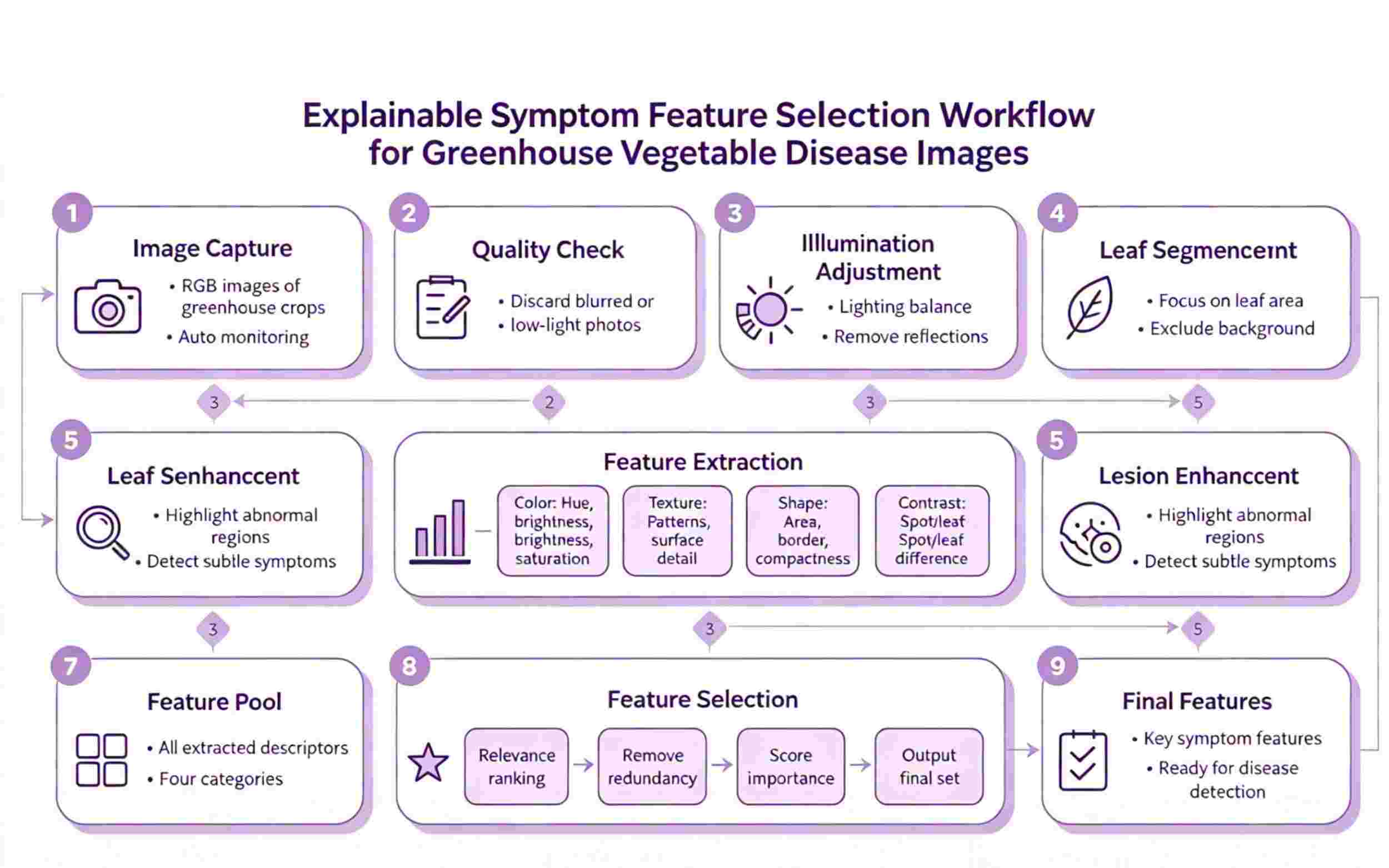
The disease-detection system model for greenhouse vegetables must be very accurate, simple to understand, and compatible with a low-cost monitoring apparatus. The majority of deep learning techniques necessitate large-scale annotated images and provide less insight into the visual symptoms that influenced the classification choice. Make a selection of explainable features. This study used a Random Forest algorithm to detect crop diseases in photos of greenhouse vegetables. Using a method, extract lesion color, texture, form, boundary, and local contrast features from illness candidate locations. Then, use a relevance-redundancy-importance selection strategy to create a small set of symptom-sensitive features. The chosen features are used to train a Random Forest classifier, and category-level illness difference is interpreted using feature significance analysis. Experimentally evaluate the computational efficiency, illumination robustness, confusion among related diseases, feature reduction ratio, and detection accuracy. With a general accuracy of 94.3%, a macro-F1 score of 93.6%, a feature reduction rate of 61.8%, and an average inference speed of 6.4 ms per image, all of the metrics in the suggested model have produced excellent results. As a result, the selected symptom descriptors will perform well in categorization and offer more comprehensible features at the representation level.
Downloads
Published
How to Cite
Issue
Section
License
Copyright (c) 2023 Alexandra Marin, Mariana Constantinescu, Walter Rentea

This work is licensed under a Creative Commons Attribution-NonCommercial-ShareAlike 4.0 International License.