Robust IoT Device Fingerprinting and Camouflage Detection Based on Residual Attention Networks
DOI:
https://doi.org/10.64972/jiic.2025v3.225p12s:154-169Keywords:
IoT Security, Device Fingerprinting, Camouflage Detection, Residual Attention NetworkAbstract
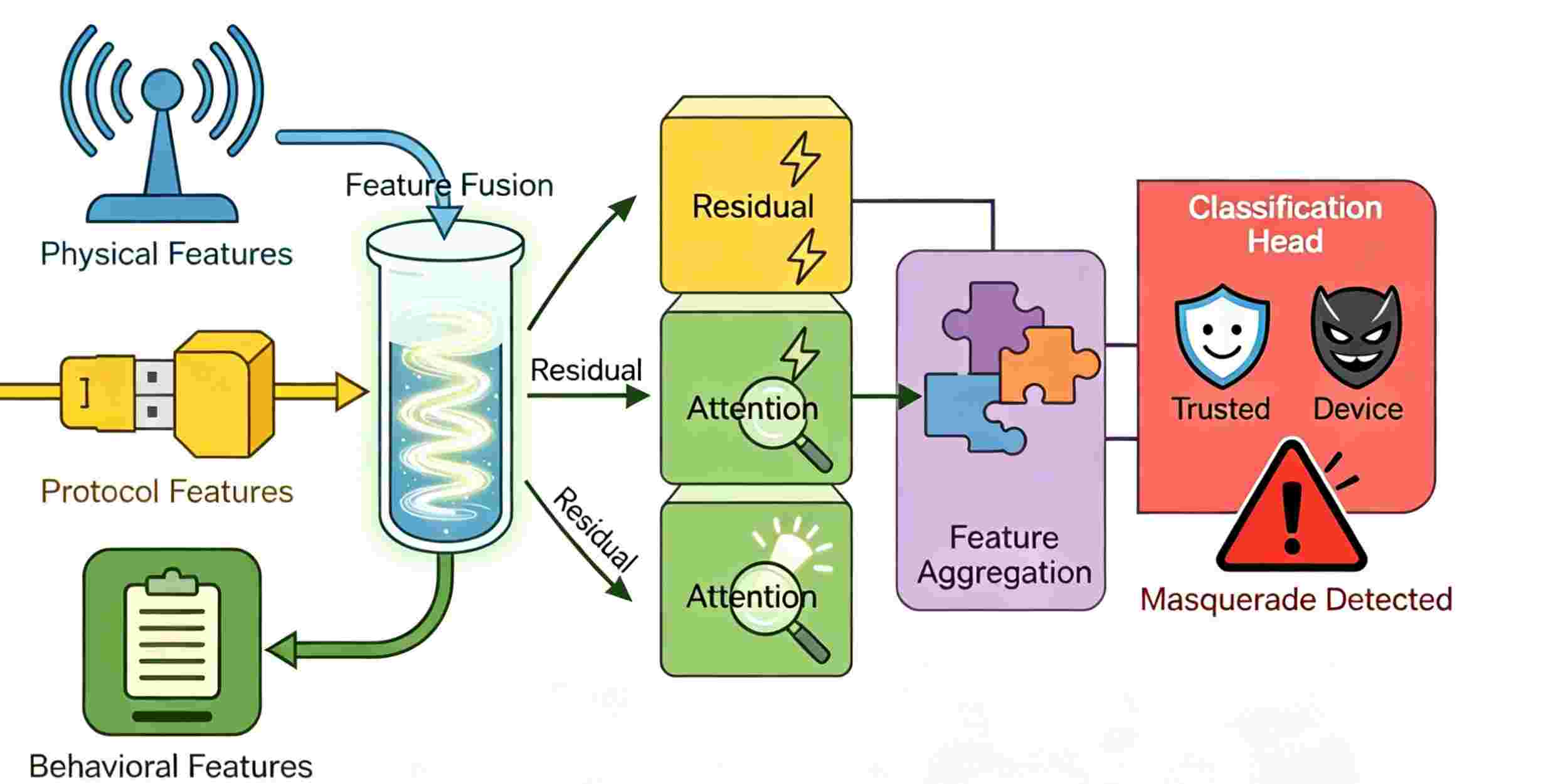
The widespread use of the Internet of Things (IoT) has created new security issues, and attackers have now created a variety of stealth techniques to get beyond conventional fingerprinting technology. The goal of this work is to address the current issues with Internet of Things (IoT) authentication. bolster device fingerprinting and enhance the detection of camouflaged impersonators using a novel residual attention neural network framework. Feature extraction using many modalities for multidimensional data collection on network behaviour, physical-layer signals, and high-level operational statistics of different devices. More than 25 different kinds of IoT devices from different manufacturers, including those with both normal and hostile behaviours, were methodically simulated using a fully functional experimental testbed. According to the aforementioned findings, this method's recall and precision rates surpass 96%, and its classification accuracy in a high-intensity camouflage attack surpasses 97%. In a hostile setting, the performance decline was less than 3.7%. The model can be implemented on the edge at the necessary speed and within the power restrictions, according to resource analysis. Because the system functions well in all conditions and at all times, it is less likely to be mistaken for a false alert. Thus, the application value of a hybrid residual-attention module for secure adaptive IoT device identification in a network has been confirmed based on the aforementioned analysis.
Downloads
Published
How to Cite
Issue
Section
License
Copyright (c) 2025 Czesława Lucyna Kamińska, Edyta Dziuba, Malwina Kasprzakowa

This work is licensed under a Creative Commons Attribution-NonCommercial-ShareAlike 4.0 International License.