Dynamic Embedding Update Method for Email Spam Filtering Based on FastText
DOI:
https://doi.org/10.64972/jiic.2025v3.222p9s:111-126Keywords:
Email Spam Filtering, Dynamic Embedding, FastText, Online Learning, Adaptive NLPAbstract
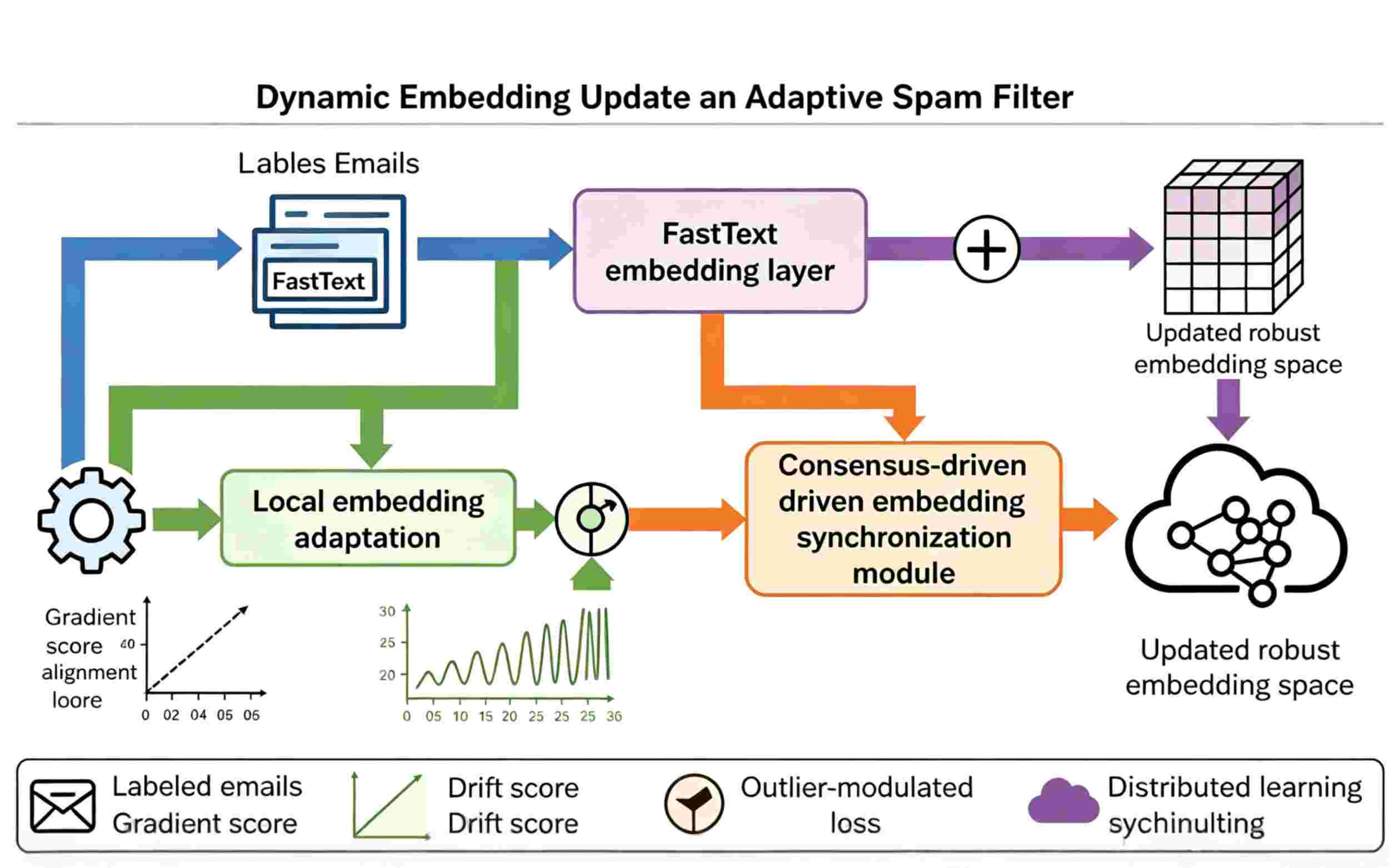
The way emails are represented must also be adjusted in light of the shift in spam. In this research, a dynamic FastText-based spam filter with explicit semantic drift regularization and realtime context-driven embedding updates is presented. In order to react swiftly to changes in natural language and focused adversarial attacks, the word vector representations of fresh email data should be systematically tracked and recalibrated in real time upon arrival. A hybrid dataset of 162,000 emails from public and industrial benchmarks was used for numerous studies. The findings demonstrate the superior classification performance of the dynamic embedding strategy: recall for the minority class (ham) has increased to 0.935, accuracy is 96.3%, and macro F1-score is 0.943. The suggested model has maintained stability with standard deviations of less than 1.1% in important metrics and decreased error propagation to less than 5% despite extreme content drift when compared to static embeddings and transformer-based baselines. Additionally, ablation studies have demonstrated that the adaptive module is required to enhance edge clarity and stability. In summary, this work demonstrates that the operational usefulness and robustness of contemporary email spam filters in hostile or unstable contexts can be enhanced by the speed of adaptation for real-time embedding.
Downloads
Published
How to Cite
Issue
Section
License
Copyright (c) 2025 Jarosław Jędras, Przemysław Seweryn Grzelak

This work is licensed under a Creative Commons Attribution-NonCommercial-ShareAlike 4.0 International License.