Urban Air Quality Index Prediction Based on Integrated Random Forest and XGBoost Models
Keywords:
Ensemble Learning, Spatiotemporal Analysis, Urban Air QualityAbstract
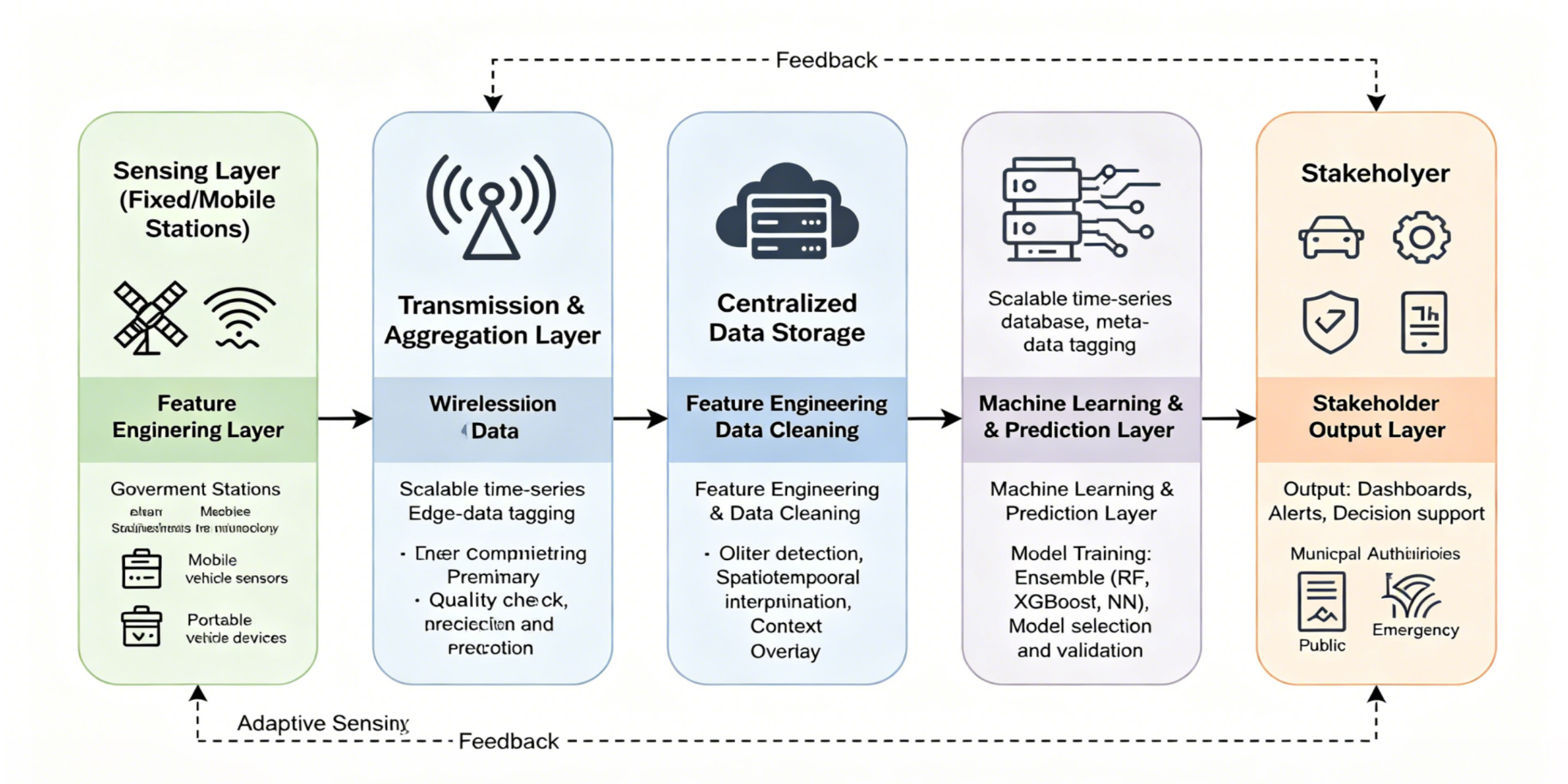
The air in cities all around the world is also adversely affected by pollution from roads and other activities. This research presents an integrated ensemble framework in response to the aforementioned shortcomings in the current deterministic and single-machine learning models for air quality index (AQI) prediction in metropolitan settings. After gathering a variety of spatiotemporal data using a dense fixed and mobile sensor network, a number of feature engineering techniques are employed to extract geographically and temporally important physical features. Create a Random Forest and XGBoost model that can use neural meta-learners to increase prediction accuracy, stability, and interpretability. According to the experiment, the ensemble system is stable in the face of abrupt contamination or missing data and has a comparatively modest inaccuracy. Integrated feature contribution analysis can be utilized to identify the reasons for variations in the AQI and provide practical guidance for pertinent countermeasures. The platform's modular design allows for expansion and adaptation to new developments in urban data infrastructure. In summary, the aforementioned findings demonstrate that spatiotemporal data fusion and ensemble modeling may create a trustworthy, high-resolution air quality forecast; hence, a stable foundation has been supplied for the intelligent operation of smart cities and extended intelligent deployment across various locations.